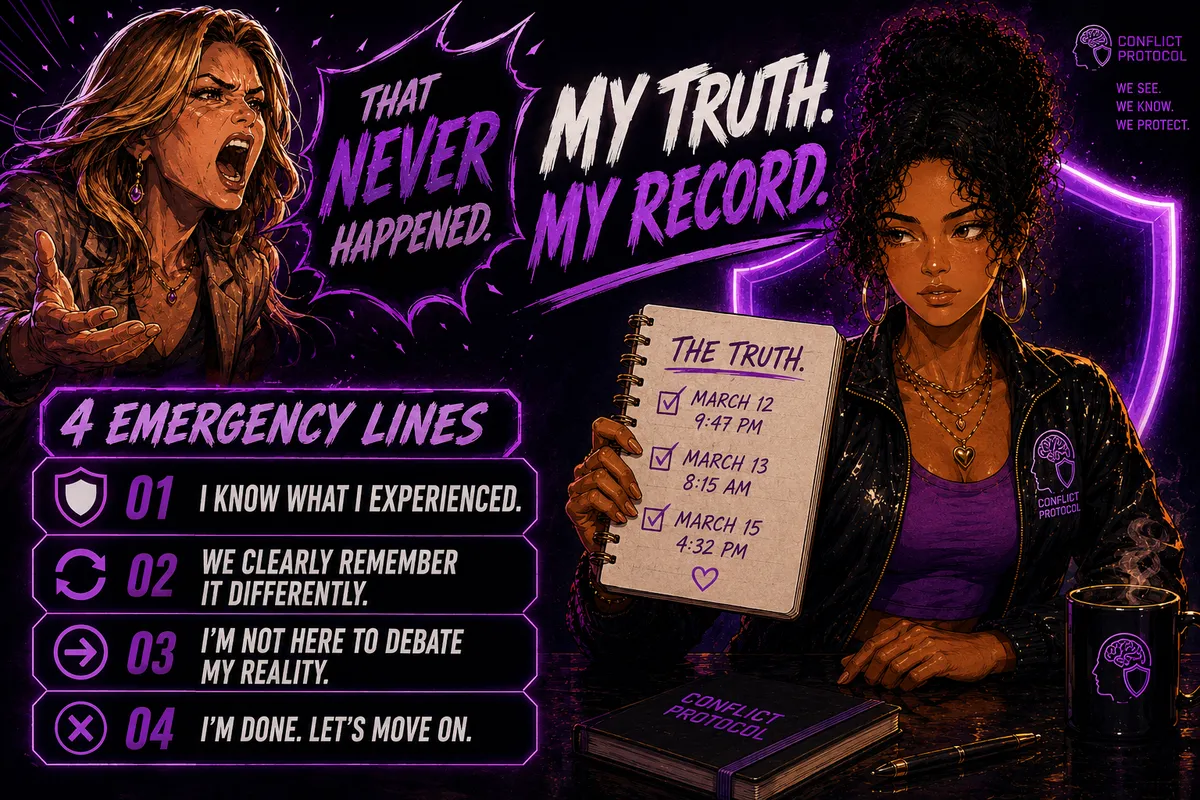
Gaslighting Responses: Scripts for Memory Denial and Reality Pressure
Gaslighting is not every disagreement about memory. Treat it as a pressure move when denial, certainty, or revision is used to make you abandon your account of what happened. The aim of a response is not to force a confession. The aim is to stay anchored enough to choose a boundary, a written record, or an exit.
Aftermath
When the script fails
If the first line does not calm the room, stop treating the conversation like a memory courtroom. The goal is to keep your next step intact, not make them certify your reality.
If they deny it again
One anchor is enough. More timestamps can become more fog.
We remember it differently. I'm not debating the memory all night.
If they demand proof
Use proof only when documentation is the next step. Do not use it to beg for permission to set a limit.
I am not trying to win a transcript fight. I am saying what I need going forward.
If your memory becomes the whole trial
Move from the disputed past to the present boundary.
The detail I am clear on is that I do not want this repeated.
If you feel watched, threatened, or punished
Stop optimizing the wording. Safer support matters more than the perfect sentence.
Scripts are for ordinary pressure and difficult conversations. If you are afraid of the person, being monitored, threatened, or punished for setting limits, prioritize safety and outside support over saying the perfect line.
What gaslighting means in plain language
In everyday conversation, gaslighting means repeated reality pressure: someone denies, rewrites, minimizes, or questions your perception until the argument becomes whether you are allowed to trust yourself.
The useful distinction is pressure plus pattern. One honest memory difference is not gaslighting. A recurring move that makes you drop the event, defend your sanity, or accept their version as the only permitted version is a different problem.
What it sounds like
Gaslighting often sounds certain, dismissive, and final. The words may be calm or dramatic, but the effect is the same: your account is treated as defective before it can be discussed.
- That never happened.
- You always twist things.
- You are remembering it wrong again.
- Everyone knows you exaggerate.
- You are too sensitive to talk to.
What it is not
Do not use the label for every disagreement, imperfect memory, different interpretation, or person who needs time to think. Two people can remember details differently without either one manipulating the other.
The label becomes useful only when the denial creates a trap: you are pushed to prove your memory forever while the original behavior disappears.
Why memory debates can trap you
A memory trial has no finish line. You bring one detail, they dispute the detail. You bring a timestamp, they attack your motive. You bring a witness, they say you coached them. The argument keeps moving while your boundary waits outside.
Anchor to your account instead of asking them to certify it. You can say what you remember, what you will do next, and what you will not keep debating.
I remember it differently, and I am acting from my account.
I am not going to argue my memory in circles.
The detail I am clear on is that I do not want this repeated.
You do not have to agree with my memory for me to set this limit.
Wrong vs better
The better line is not softer. It is less available for derailment.
- Wrong: You have to admit exactly what you said before I can set a boundary.
- Better: We remember it differently. I am talking about what I need going forward.
- Wrong: Here are twelve reasons I am not crazy.
- Better: I am not debating whether I am reasonable enough to object.
- Wrong: You are gaslighting me and everyone knows it.
- Better: This is moving away from what happened and into whether I am credible. I am stopping here.
Text-message examples
Text helps when live discussion keeps becoming fog. Keep the message factual and short. Do not send a transcript-length defense.
I remember the conversation differently. I am not available to keep debating it tonight.
My decision is based on what I experienced. Please do not bring this up again today.
I am writing this down so the next step is clear: I am not agreeing to that plan.
If you want to discuss logistics, send them here. I am not continuing a memory argument.
Workplace examples
At work, avoid clinical labels and keep the record operational. The goal is clarity, not a diagnosis of the other person.
My notes show a different agreement. I am going to follow the written scope unless we update it here.
I want to keep this factual: the deadline discussed was Friday, not Wednesday.
Let's put the next decision in writing so we do not keep revisiting what was said.
I am available to resolve the task. I am not available for comments about my memory or character.
When to stop engaging
Stop when the conversation makes you less clear with each round, when the denial pattern repeats after you have anchored once, or when the safer channel is written documentation, HR, a support person, or no further discussion.
If the interaction involves threats, coercion, stalking, violence, or fear for safety, scripts are not a safety plan. Use qualified local support.
I have answered this. I am not continuing tonight.
This is going in circles, so I am ending the conversation here.
Future logistics need to be in writing.
Related techniques and patterns
Techniques: Don't Over-Explain - No JADE, Boundary Setting, Broken Record, Document the Record.
Patterns: Gaslighting / Repeated Reality Undermining, Memory Denial, Blame Shifting.
Patterns and techniques
Patterns and techniques in this article
Pressure pattern to watch for:
How to defend yourself:
These tags describe possible interaction patterns, not diagnoses or proof of intent. Look at repetition, context, power, and what happens after you respond.
Simulator preview
See how reply feedback will work.
This static sample shows the feedback format being built for interactive practice.
- A sample persona adds pressure.
- A sample reply gives the pressure more handles.
- The preview flags the exact phrase that weakens the line.
- A cleaner version shows the next move.
"That never happened. You always twist things."
"No, it did happen. I remember exactly where we were and what you said."
Memory-trial flag: proving every detail keeps you inside the argument they chose.
Flagged phrase: "I remember exactly where we were"
"We remember it differently. I'm not debating the memory all night. I'm talking about what I need going forward."
Rises when memory gets challenged
Recovers when the line exits the trial
Memory denial / blame reversal
Refuse the memory trial
FAQ
Is every memory disagreement gaslighting?
No. Honest memory differences happen. Treat it as gaslighting only when denial, certainty, or revision makes you abandon your account.
Should I call someone a gaslighter in the moment?
Usually it is cleaner to name the behavior: 'This is becoming a debate about whether I can trust my memory.' Labels can escalate the loop.
What is the shortest gaslighting response?
Try: 'I remember it differently, and I am not arguing my memory in circles.'
Sources and further reading
- What is Gaslighting? The National Domestic Violence Hotline, The Hotline, accessed 2026-07-07.
- The Sociology of Gaslighting Paige L. Sweet, American Sociological Review, accessed 2026-07-07.
- Deny, Attack, and Reverse Victim and Offender (DARVO) Sarah Harsey and Jennifer J. Freyd, Journal of Aggression, Maltreatment & Trauma, accessed 2026-07-07.