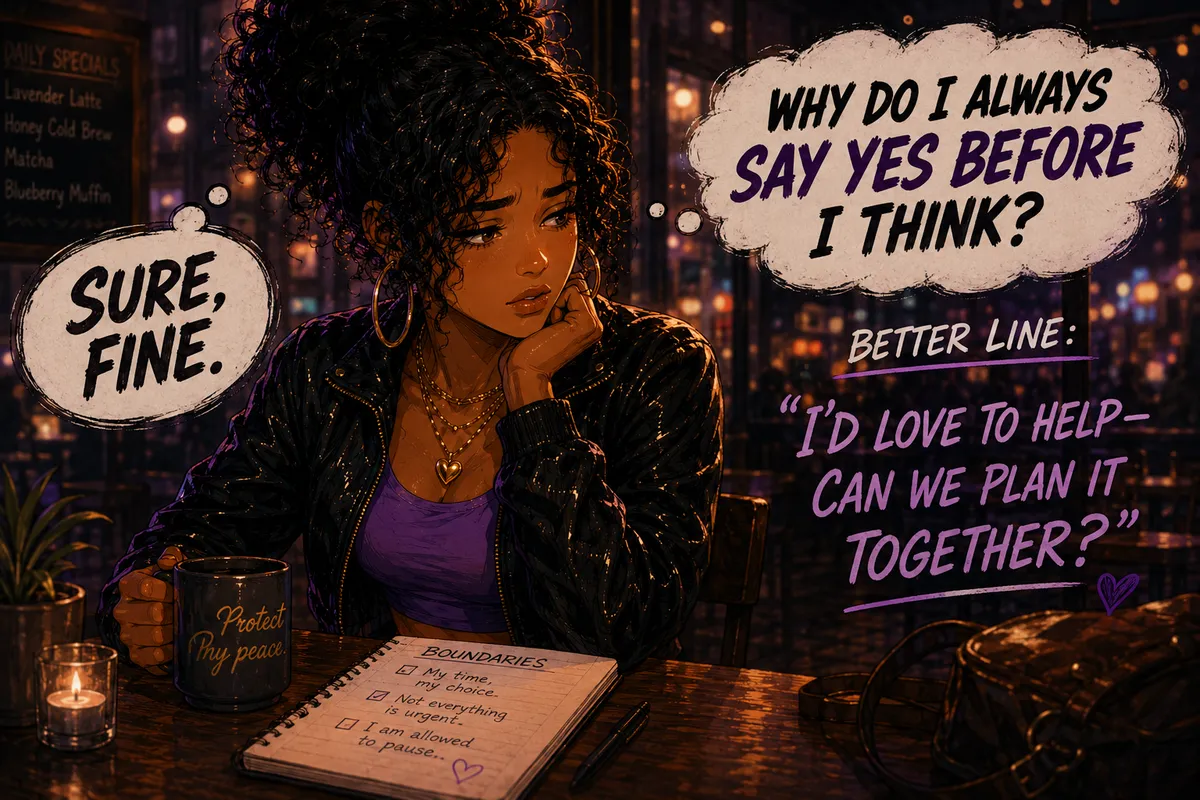
Emergency Boundary Scripts for When Your Mind Goes Blank
When pressure hits, you do not need a perfect speech. Choose the smallest sentence that buys time, protects the no, stops repetition, or gets you out of the loop.
Quick answer
When your mind goes blank, use the smallest sentence that protects time, choice, or exit.
Buy time
- I need a second before I answer.
- I need to check before I commit.
- I cannot answer that on the spot.
- If you need an answer now, it is no for now.
Say no
- That does not work for me.
- I am not available for that.
- I cannot take that on.
- No, I am not agreeing to that.
Stop explaining
- I have answered this. I am not adding more reasons.
- You do not have to agree with my reason.
- My answer stays the same.
Stop repeated asking
- I have already answered.
- Repeating the question will not change my answer.
- If there is nothing new, I am ending the conversation.
Leave the conversation
- I am going to step away now.
- I will continue when we can keep this respectful.
- This is going in circles, so I am stopping here.
Correct a pressured yes
- I answered too quickly. I need to correct that.
- After checking, I am not available.
- I agreed under pressure. I am revisiting the answer now.
Work pressure
- What should move if this becomes the priority?
- I can do A or B today, not both.
- Please put the priority change in writing.
Family guilt
- I care about you. I am still saying no.
- I know you are disappointed. I am not available.
- Gratitude does not mean automatic agreement.
Memory denial
- We remember it differently.
- I am not debating the memory all night.
- The detail I am clear on is what I need going forward.
Closing
Choose three lines, not thirty. Save the ones that match your most common pressure: one pause, one boundary, and one exit.
Related paths
Quick reference: /pocket-card/.
What to say: /what-to-say/.
Recovery guide: /you-froze-today-start-here/.
Deeper guide: /articles/boundary-setting-scripts/.
Practice: Practice your pause, boundary, and exit.
Patterns and techniques
Patterns and techniques in this article
How to defend yourself:
These tags describe possible interaction patterns, not diagnoses or proof of intent. Look at repetition, context, power, and what happens after you respond.