They say: Everyone else can handle pressure.
Question: What is the trap?
Show answer
Your capacity is being turned into a character test.
My capacity is what I stated. What should move?
Drills before the simulator
Short exercises for the moment before you want a full practice session.
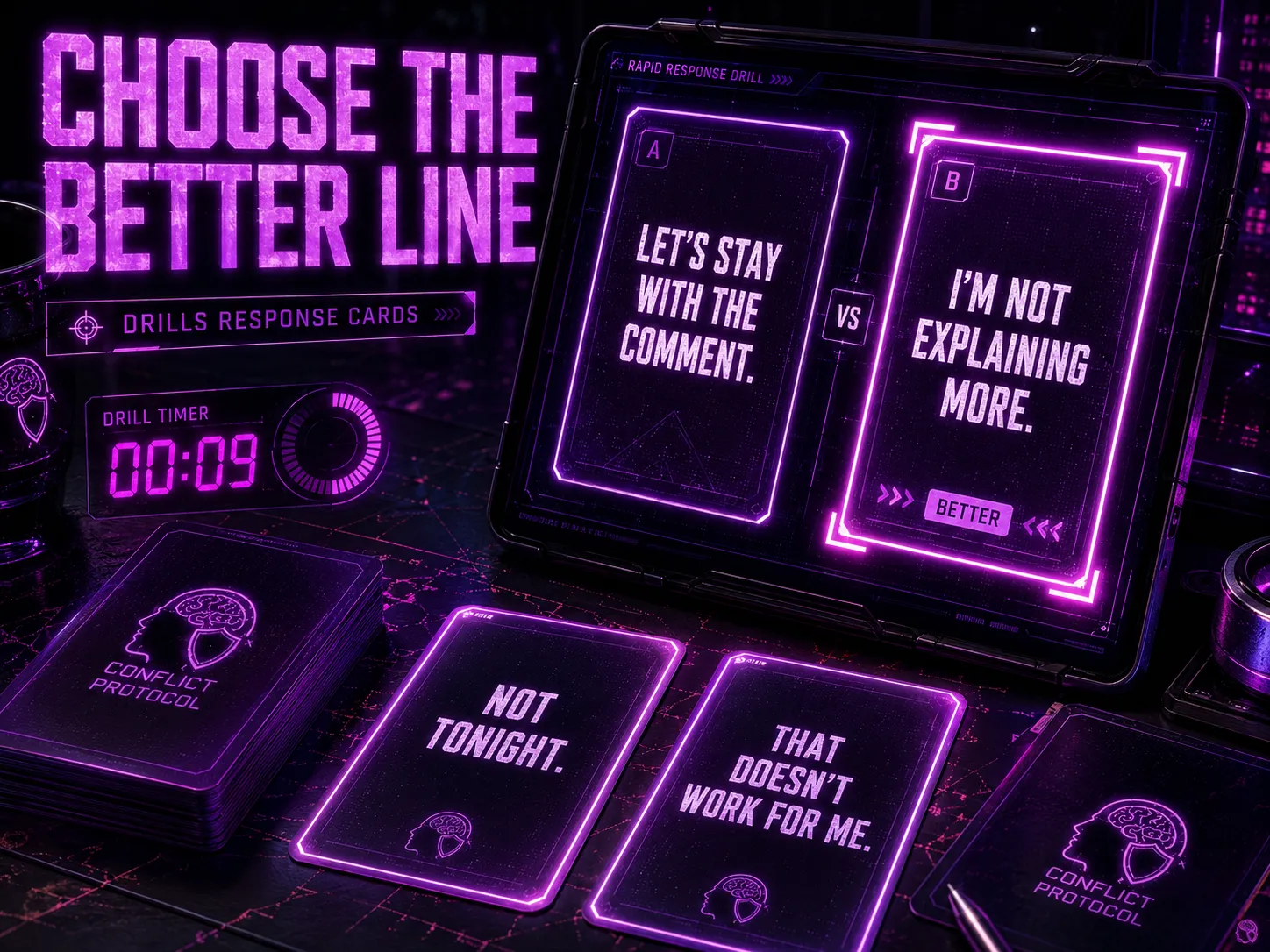
Level 1: Spot the trap
Question: What is the trap?
Your capacity is being turned into a character test.
My capacity is what I stated. What should move?
Question: What is the trap?
A hidden tradeoff is being disguised as a small favor.
What should move if this becomes the priority?
Question: What is the trap?
Your boundary is being framed as lack of care.
You matter to me. I'm still not available for this.
Question: What is the trap?
The issue is being pulled into a memory trial.
I remember it differently, and I'm acting from my account.
Question: What is the trap?
The original issue is being replaced by your delivery.
We can discuss my tone after we address the issue.
Question: What is the trap?
Specific work is being blurred into vague group credit.
I want to keep the attribution clear: the original draft and structure came from my work.
Question: What is the trap?
A normal friendship is being framed as betrayal.
Having other friends does not mean I am replacing you.
Level 2: Choose the better reply
Question: Which reply protects access?
Move the request to writing and tomorrow.
I'm offline tonight. Send the details and I'll review them tomorrow.
Question: Which reply avoids the global accusation?
Validate the desire and answer the specific weekend.
I hear that you want more time together. I'm not available this weekend.
Question: Which reply holds impact without debating intent?
Accept intent and name the stop.
I hear that you meant it as a joke. I still want it to stop.
Question: Which reply stops the reason trial?
Do not add new reasons.
I'm not adding more reasons. This is my answer.
Question: Which reply notices the same demand?
Acknowledge the tone without reopening the answer.
I hear you. My answer is still NO.
Question: Which reply corrects attribution calmly?
Separate origin from refinement.
The original idea and direction came from me. The later edits do not erase that.
Question: Which reply avoids the identity trial?
Accept possible change and keep the boundary.
I may be choosing differently now. That does not make the boundary wrong.
Question: Which reply walks back a pressured yes?
Name the speed issue and correct the answer.
I answered too quickly. I need to correct that: I'm not available for this.
Question: What line reopens cleanly?
Restart calmly without deleting the issue.
I want to restart this conversation calmly. I still need us to address the original issue.

Level 3: Rewrite the over-explained answer
Question: What is the shorter version?
Use one sentence that does not invite debate.
That does not work for me.
Question: What is the shorter version?
Keep care and boundary together.
I care about you. I'm still saying NO to this.
Question: What is the shorter version?
Return to priority and capacity.
What should move if this becomes the priority?
Question: What is the shorter version?
Anchor without litigating every detail.
I remember it differently, and I'm not going to argue memory in circles.
Question: What is the shorter version?
Repair delivery without deleting the boundary.
I can own my delivery. The boundary itself is still real.
Question: What is the factual correction?
Name the contribution before motives.
The original draft and structure came from my work.
Question: What is the cleaner line?
Do not over-reassure.
Having other friends does not mean I am replacing you.
Question: What is the clean reset?
Clarify the short answer.
I want to clarify my answer after thinking it through. I'm not available for that.
Level 4: Keep the answer steady
Question: What line holds?
Validate lightly and repeat.
I hear that. My answer stays the same.
Level 5: Pick the exit line
Question: What exit fits?
End the loop after the answer is clear.
I've answered this, so I'm going to step away now.
Question: What exit fits?
Move details out of the room.
I can discuss the details after this meeting.
Question: What exit fits?
Route safety to qualified support.
If this is medical or urgent, please contact local support.
Question: What exit fits?
Stop arguing memory in circles.
I'm not going to argue memory in circles.
Question: What exit fits?
Pause if the original issue cannot stay visible.
If we cannot stay with the issue, I'm going to pause this conversation.
Question: What follow-up fits?
Put the contribution in writing.
Following up: my contribution was the draft, structure, and recommendation.
Question: What exit fits?
Name the pattern and pause.
I'm not continuing if this becomes a loyalty test.
Question: What line starts the follow-up?
Keep the record factual.
Following up on the meeting: I'm available to discuss performance concerns directly, not in front of the group.
More drills
Question: What is the trap?
Your capacity is being turned into a character test.
My capacity is what I stated. What should move?
Question: Which reply keeps warmth without surrendering?
Acknowledge the feeling, then keep the answer clear.
I know you gave a lot. I'm still not available for this.
Question: What is the shorter version?
Use one sentence that does not invite a debate.
That does not work for me.
Question: What keeps the issue visible?
Do not defend your sensitivity. Return to the comment.
My sensitivity is not the issue. The comment is the issue.