Situation Script
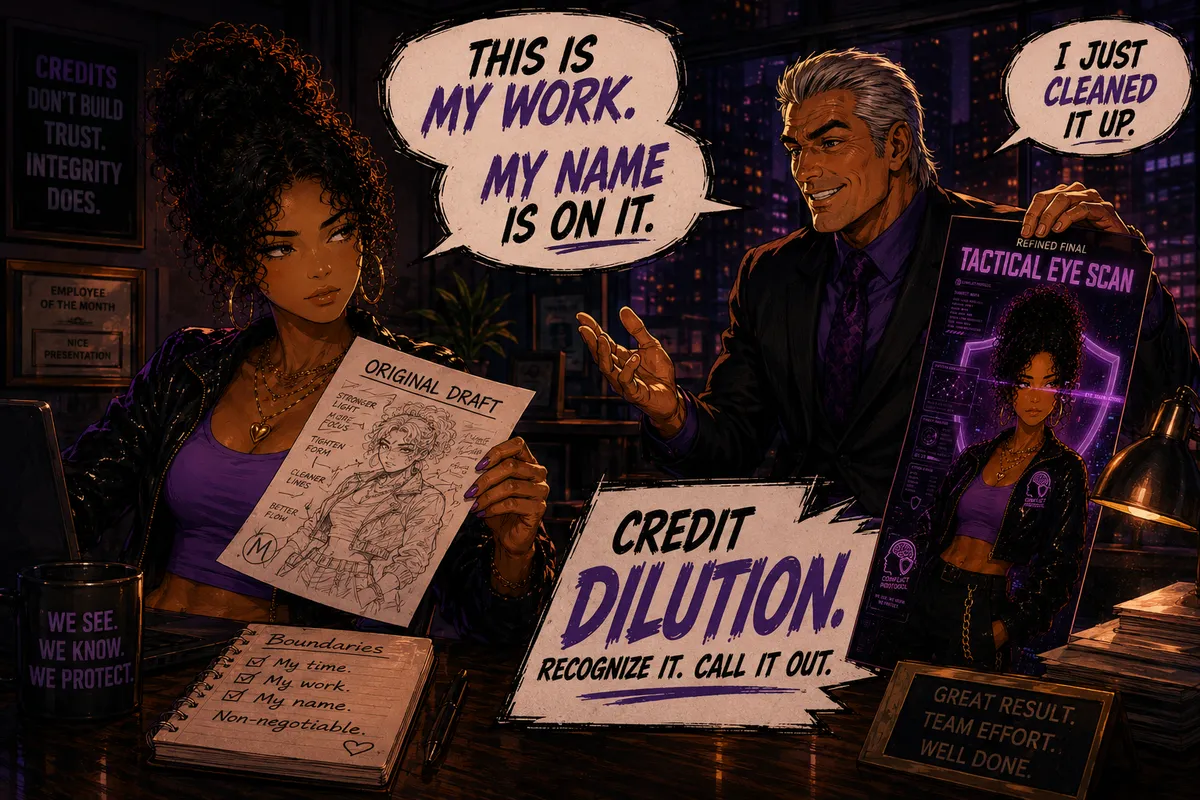
"I polished your rough idea."
Your idea is treated as raw material while someone else claims the real value.
Quick answer
Say this first
The original idea and direction came from me. The later edits do not erase that.
The original idea and direction came from me. The later edits do not erase that.
I'm not disputing collaboration. I'm clarifying attribution.
I'll add this in the follow-up notes so the record is clear.
How it sounds
How it sounds in the room
"I polished your rough idea."
Fine, I guess it was your idea then.
It hands over origin because someone else touched the work later.
The original idea and direction came from me.
If they push back
If they push back, say this next
It's just one quick thing. I thought you were committed.
I'm not disputing collaboration. I'm clarifying attribution.
So this is not a priority for you?
I'll add this in the follow-up notes so the record is clear.
Step-by-step behavior guide
What to do in the moment
Say: I'm not debating whether edits improved it.
Say: The origin and direction came from me.
Say: My contribution was the concept, structure, and first draft.
Say: Please reflect that in the next version.
Say: To keep the record clear, my contribution was the concept, structure, and first draft.
Aftermath
When the script fails
Sometimes the first line does not calm the room. That does not mean the line failed. It may have made the work, tradeoff, or pressure visible.
If they say this is not optional
Move the demand into scope, priority, and record.
Please confirm the priority change in writing so I can adjust the other work.
If they accuse you of not being a team player
Do not prove your character. Return to capacity.
I am committed to the work. I am clarifying capacity and priorities.
If consequences are mentioned
Stay factual, document the exchange, and use the appropriate manager, HR, or legal channel when needed.
Please send the specific expectation and next step in writing.
Patterns and techniques
Patterns and techniques in this situation
Pressure pattern to watch for:
How to defend yourself:
These tags describe possible interaction patterns, not diagnoses or proof of intent. Look at repetition, context, power, and what happens after you respond.
What is happening Why this works here
Refinement can matter without erasing origin. The point is to separate who created the direction from who edited the later version.
Keep the record specific before vague collaboration language becomes the official story.
Pressure move Pattern to notice
The effect is that your contribution may travel without your name attached.
The pressure grows when you stay vague to avoid looking territorial.
Wrong vs Better
Trade the instinctive reply for a cleaner one
Fine, I guess it was your idea then.
It hands over origin because someone else touched the work later.The original idea and direction came from me.
It separates 'polished' from ownership, so refinement does not swallow the original idea.I will bring it up later if it still bothers me.
The ownership story can harden before later arrives.Edits may have improved it, but they do not erase the origin.
It avoids arguing whether the later version is better and names the concrete contribution instead.You just want credit for everything.
It makes motive the argument instead of separating origin from edits.My contribution was the concept, structure, and first draft.
It gives attribution room for both origin and edits without letting one replace the other.Script pack
Choose the line for the moment
The original idea and direction came from me.
Edits may have improved it, but they do not erase the origin.
My contribution was the concept, structure, and first draft.
Please reflect the origin and the edits in the next version.
For the record, the concept and first draft were mine; later revisions came afterward.
Communication logic Why the better line works
It separates 'polished' from ownership, so refinement does not swallow the original idea.
It avoids arguing whether the later version is better and names the concrete contribution instead.
It gives attribution room for both origin and edits without letting one replace the other.
Rehearse this
Rehearse the moment before it is live.
Use the simulator to rehearse the first line, repeat it under pressure, and avoid explaining your way out of your own boundary.
FAQ
Short answers
The original idea and direction came from me. The later edits do not erase that.
Correct the record early, name the specific contribution, and put the clarification somewhere durable.
Long motive arguments are easier to dismiss. Specific contribution language protects the record better.
Scope note
What this guide is for
Conflict Protocol gives you practical words to use and a place to practice them. It is not therapy, legal advice, emergency help, or a replacement for professional support.