Situation Script
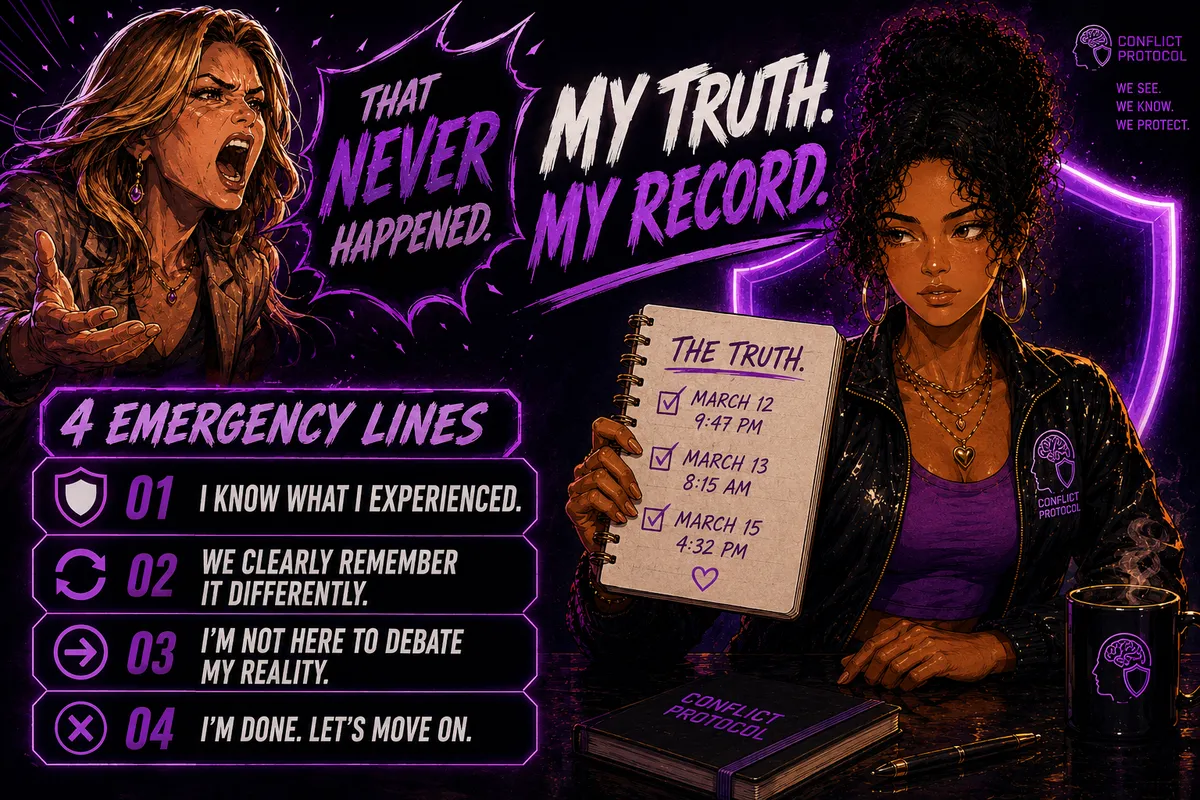
"That never happened. You always twist things."
You bring up something they said, and now you are defending your memory.
Quick answer
Say this first
I remember it differently, and I'm acting from my account.
I remember it differently, and I'm acting from my account.
I'm not going to argue my memory in circles.
You don't have to agree with my memory for me to set this limit.
How it sounds
How it sounds in the room
"That never happened. You always twist things."
Yes it did! It was Tuesday at 8:15 and you said exactly...
Facts matter sometimes, but endless detail can trap you in the memory trial.
I remember it differently, and I'm acting from my account.
If they push back
If they push back, say this next
You're making this into a problem again.
I'm not going to argue my memory in circles.
So now I'm the bad person?
You don't have to agree with my memory for me to set this limit.
Step-by-step behavior guide
What to do in the moment
What to do: Use your account as enough ground to set the next limit.
Say: I remember it differently, and I'm acting from my account.
Why: You do not need a confession before you act on your own experience.
What to do: Do not stack every timestamp unless documentation is the real next step.
Say: I'm not going to argue my memory in circles.
Why: Endless detail can turn clarity into fog.
What to do: Move from the disputed past to the present boundary.
Say: The detail I'm clear on is that I don't want this repeated.
Why: It gives the conversation something concrete to respect.
What to do: Let disagreement exist without handing it control.
Say: You don't have to agree with my memory for me to set this limit.
Why: Their disagreement is not a veto.
What to do: Keep private notes if this is recurring or work-related.
Say: I have the date and message noted. The next step I'm taking is this.
Why: Documentation protects clarity when live conversation keeps warping it.
Full exchange
How the pressure can mutate
- Them: That never happened. You always twist things.
- You: I remember it differently, and I'm acting from my account.
- Them: I am completely sure. You do this every time.
- You: Your certainty does not make me drop my account.
- Them: So now I am a liar?
- You: I am not putting your character on trial. I am saying what needs to change.
- Them: This is why nobody can talk to you.
- You: I am stopping the memory trial here. Future logistics need to be in writing.
The exit matters more than winning the memory trial.
Aftermath
When the script fails
When denial becomes certainty, do not bring your whole memory to trial. Anchor once, name the boundary, and stop giving the fog more material.
If they deny it again
Repeat the anchor once.
We remember it differently. I'm not debating the memory all night.
If they demand proof
Proof is for records and decisions, not for begging to be believed.
I can refer to the message. I am not arguing the whole history.
If they flip it into your character
Return to the current issue.
I am not putting my character on trial. I am saying what needs to change.
If you feel unsafe or monitored
Do not confront harder. Prioritize support and distance.
Scripts are for ordinary pressure and difficult conversations. If you are afraid of the person, being monitored, threatened, or punished for setting limits, prioritize safety and outside support over saying the perfect line.
Patterns and techniques
Patterns and techniques in this situation
Pressure pattern to watch for:
How to defend yourself:
These tags describe possible interaction patterns, not diagnoses or proof of intent. Look at repetition, context, power, and what happens after you respond.
What is happening Why this works here
The conversation has moved from the event to whether you are allowed to trust yourself.
If you spend the whole conversation chasing agreement, the original issue disappears.
Pressure move Pattern to notice
They may be trying to make their agreement the condition for your reality.
If you keep trying to win the memory trial, you may never reach the boundary or next step.
Wrong vs Better
Trade the instinctive reply for a cleaner one
Yes it did! It was Tuesday at 8:15 and you said exactly...
Facts matter sometimes, but endless detail can trap you in the memory trial.I remember it differently, and I'm acting from my account.
The line stops making their agreement the gatekeeper for your next action.You're gaslighting me!
Naming the pattern can help, but in a hot moment it may become another argument.I'm not going to argue my memory in circles.
It lets you act from your account without requiring a confession.Maybe I remembered wrong.
Do not abandon your own account just because they deny it.You don't have to agree with my memory for me to set this limit.
The line stops making their agreement the gatekeeper for your next action.Script pack
Choose the line for the moment
I remember it differently, and I'm acting from my account.
I'm not going to argue my memory in circles.
You don't have to agree with my memory for me to set this limit.
The detail I'm clear on is that I don't want this repeated.
I have the date and message noted. The next step I'm taking is this.
Communication logic Why the better line works
The line stops making their agreement the gatekeeper for your next action.
It lets you act from your account without requiring a confession.
Rehearse this
Rehearse the moment before it is live.
Use the simulator to rehearse the first line, repeat it under pressure, and avoid explaining your way out of your own boundary.
FAQ
Short answers
I remember it differently, and I'm acting from my account.
Anchor to your account and move to the next boundary or record instead of arguing memory in circles.
More detail can become a memory trial. Use enough detail to anchor yourself, then move to the boundary.
Scope note
What this guide is for
Conflict Protocol gives you practical words to use and a place to practice them. It is not therapy, legal advice, emergency help, or a replacement for professional support.