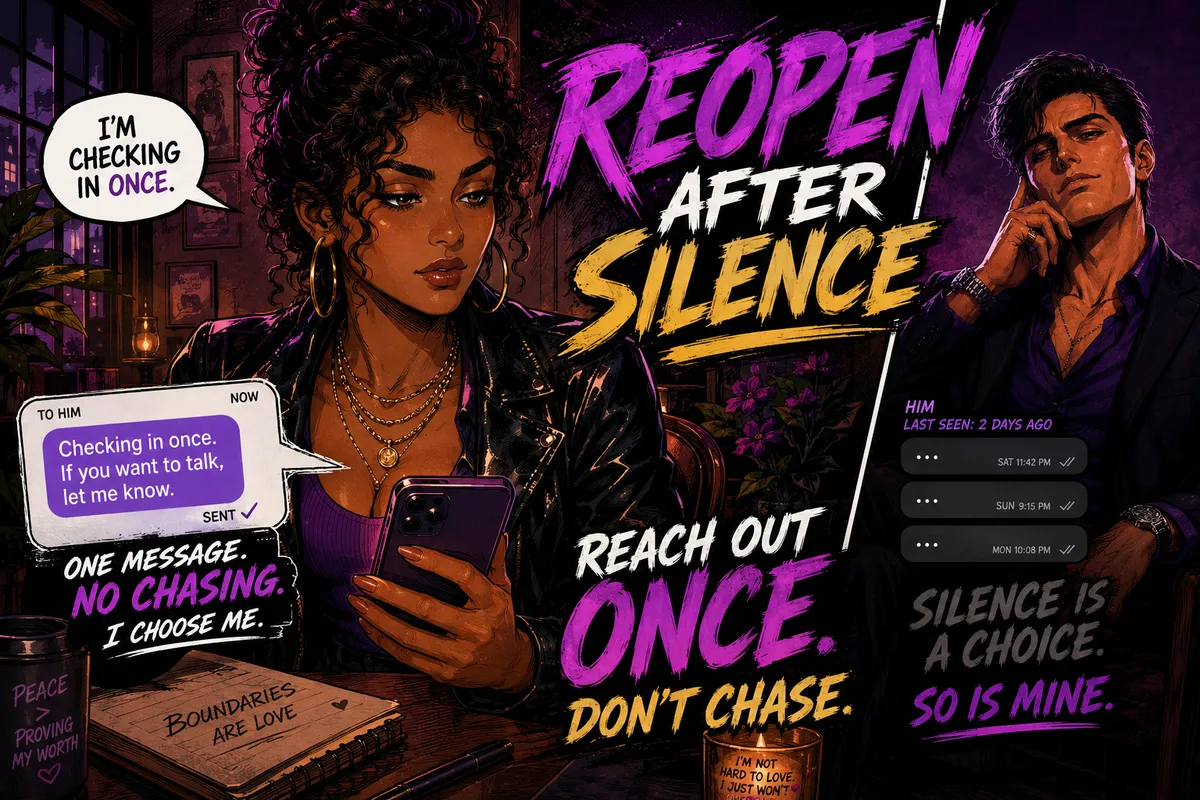
How to Respond to Stonewalling and Silent Treatment
Silence can mean different things. A healthy pause has a purpose and a return point. Stonewalling or silent treatment becomes a problem when withdrawal is used to avoid, punish, control, or make you chase contact until your boundary disappears.
Aftermath
When the script fails
Silence can make you want to send a better message, then another, then an apology you do not mean. One clean opening is enough.
If they punish you with silence
Leave one return path, then stop feeding the chase.
I am open to talking directly. I am not sending more messages tonight.
If they say your boundary caused the silence
Do not apologize the boundary away just to get contact back.
I want contact. I am not taking back the boundary to get it.
If they return with blame
Own only your part.
I can own my delivery. I still need us to address the original issue.
If the silence is part of a broader safety pattern
Do not treat a script as a safety plan. Use outside support.
What stonewalling or silent treatment looks like
Stonewalling can look like shutting down, refusing to answer, acting busy, leaving the room without a return point, or becoming unreachable whenever the original issue appears.
Silent treatment adds pressure: you are left guessing what you did wrong, sending repeated messages, or apologizing for things you do not mean just to restart contact.
What it is not
A timeout is not the same thing as silent treatment. People sometimes need space to regulate before a hard conversation can continue.
The difference is clarity. A healthy pause says when or how the conversation will resume. Punitive silence keeps the other person guessing.
I need 30 minutes to calm down. I will come back at 7.
I want to talk, but I need a pause first.
I am not ignoring you. I am taking space so I can respond better.
Scripts for reopening calmly
Offer one clean opening. Do not flood the silence with a dozen versions of the same message.
I am open to talking directly when you are ready.
I want to understand what happened. I am available for a direct conversation, not guessing.
I can talk tonight if we can stay with one issue.
If you need space, please name a time to return to this.
When to stop chasing
After one clear invitation, stop sending messages meant only to reduce your anxiety. Chasing often teaches the silence that it works.
Stopping the chase is not cold. It is a boundary around repeated pursuit.
I have left the door open. I am not sending more messages tonight.
I am going to give this space and return tomorrow.
I am not going to guess what I did wrong. If you want to talk, say it plainly.
Follow-up message examples
Use a short message that names the return point and protects the original issue.
Following up from yesterday: I still want to talk about the plan. I am available after 6.
I am willing to repair the way we handled this. I am not willing to drop the boundary itself.
If we are not ready to talk, let's pause until tomorrow instead of sending indirect messages.
I am going offline now. We can revisit this when direct conversation is possible.
Wrong vs better
The better line creates a return path without begging the silence to end.
- Wrong: Please answer me. I will do anything, just stop ignoring me.
- Better: I am open to talking directly. I am not going to keep sending messages tonight.
- Wrong: Fine, I am sorry for everything.
- Better: I can own my part. I am not taking blame just to restart contact.
- Wrong: You always stonewall because you are manipulative.
- Better: I need a return point if we pause. Otherwise I am stepping back.
Related situations
Open the scenario: "I thought we were done talking about that.".
Related techniques and patterns
Techniques: Boundary Setting, Broken Record, Validation, I-Statements.
Patterns: Punitive Silence, Guilt Trip.
Patterns and techniques
Patterns and techniques in this article
Pressure pattern to watch for:
How to defend yourself:
These tags describe possible interaction patterns, not diagnoses or proof of intent. Look at repetition, context, power, and what happens after you respond.
FAQ
How many messages should I send after silent treatment?
Send one clear opening if it is safe and appropriate. After that, stop chasing and choose a return point.
Is taking space always stonewalling?
No. A healthy pause can be useful when it has a purpose and a return time.
What should I say when someone refuses to talk?
Try: 'I am open to talking directly when you are ready. I am not going to guess or send repeated messages tonight.'
Sources and further reading
- The Four Horsemen: Stonewalling Ellie Lisitsa, The Gottman Institute, accessed 2026-07-07.
- R is for Repair Zach Brittle, The Gottman Institute, accessed 2026-07-07.
- Power and Control The National Domestic Violence Hotline, The Hotline, accessed 2026-07-07.