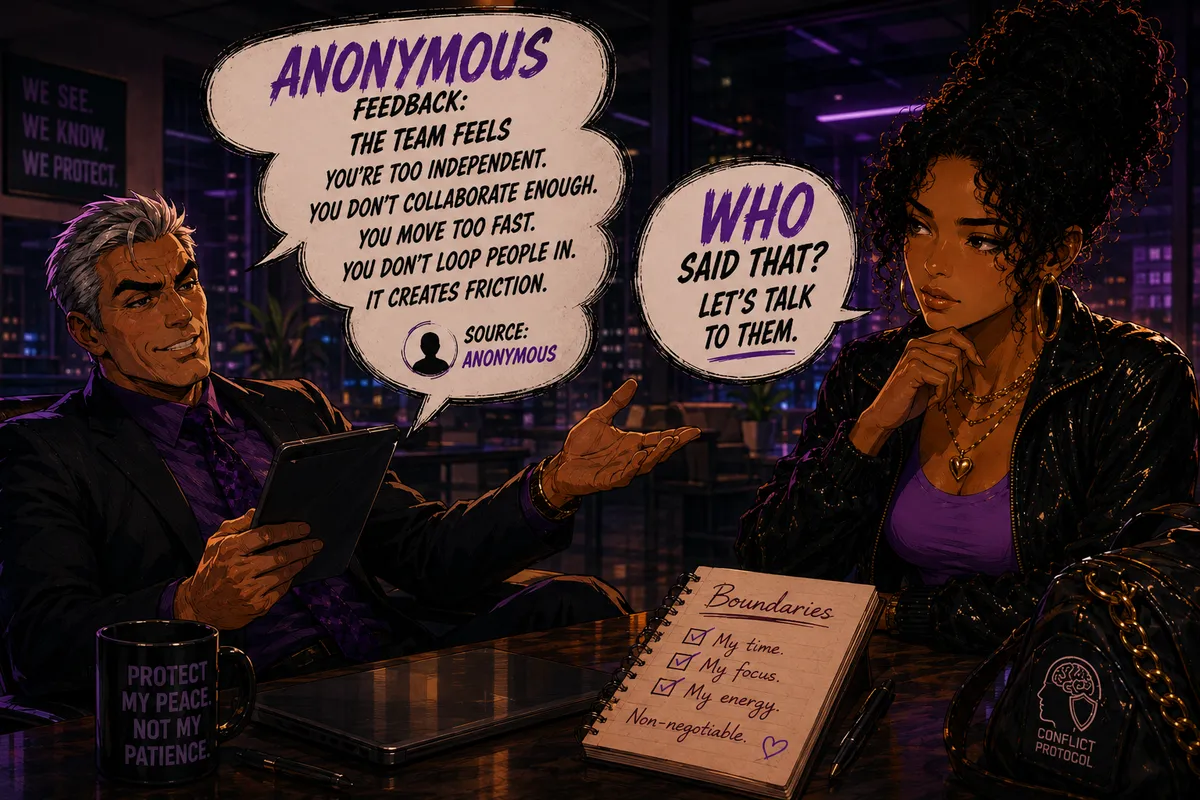
Workplace Manipulation Tactics: Simple Scripts for Scope, Urgency, Credit, and Public Pressure
Imagine one very long week at work. On Monday, a small task grows three extra sections. On Tuesday, everything becomes urgent. On Wednesday, someone presents your idea without your name. On Thursday, feedback turns into a public performance. By Friday, your commitment is being questioned because you do not want to spend the weekend fixing everyone else’s planning. Different tactic. Same effect: the work becomes vague, personal, and harder to answer. The good news is that your reply does not need to be clever. At work, come back to five things: What is the scope? Who owns it? When is it due? What becomes the priority? What needs to be written down? Let’s walk through the most common versions.
Aftermath
When the script fails
At work, the pressure often changes costume: urgency becomes loyalty, loyalty becomes performance, performance becomes a warning. Keep the record boring and specific.
If they say this is not optional
Treat it as a priority change, not a personality test.
Please confirm the priority change in writing so I can adjust the other work.
If they call it a commitment issue
Return to scope, owner, deadline, and tradeoff.
I am committed to the work. I still need the scope and tradeoff named.
If they threaten consequences
Do not argue your attitude. Ask for the expectation in a channel that can be checked.
Please send the specific expectation and consequence in writing so I can respond accurately.
If it becomes your last warning
Ask for the expectation, metric, and next step in writing. Consider the appropriate manager, HR, or legal channel where relevant.
Please send the specific expectation and next step in writing so I can respond accurately.
When the scope keeps growing
A quick summary becomes a report. The report becomes a deck. The deck suddenly needs “just a few” new slides.
Name new work as new. Do not let politeness turn it into a silent commitment.
“That is beyond the original scope. What should move if this becomes the priority?”
“I can complete the summary today. The full deck needs a separate timeline.”
When everything is suddenly urgent
Urgency often arrives before the details.
“If this is urgent, which current priority should pause?”
“I can do A or B today, not both. Which one is first?”
A loud request is not automatically a clear priority.
“What decision is this deadline tied to?”
When someone takes credit for your work
Correct it while the work is still in the room:
“I want to clarify attribution: the original draft and structure came from my work.”
If it was collaborative:
“Yes, and my contribution was the first version and data analysis.”
Then put it in the recap:
“Please include me as an owner on the document.”
You do not need to accuse first. Make the record accurate first.
When feedback becomes public pressure
If there is a real work point, answer that point and move the detailed discussion:
“I can discuss the timeline after this meeting.”
“The next step is X. I’ll follow up directly on the rest.”
If ridicule or humiliation is part of it:
“I’m available for specific feedback. I’m not participating in ridicule.”
The room may need a work decision. It does not need a public trial.
When workload becomes a character test
“A real team player would make it work.”
Do not defend whether you are a good employee.
Answer the workload, not the insult wearing office clothes.
“My capacity is what I stated. What should move?”
“I’m committed to the work. I still need the scope and tradeoff named.”
Move vague pressure into writing
Written channels are useful when the story keeps changing.
Slack
“I can take this up tomorrow. Please send the scope and deadline here.”
Priority choice
“I can do A or B today, not both. Which is first?”
“Confirming the current scope is the one-page summary by Friday. A full deck would require a new deadline.”
Meeting
“Before I commit, I need the owner, deadline, and tradeoff named.”
Keep the record calm and boring. Boring records are difficult to rewrite later.
When the pressure changes costume
It may begin as urgency.
Then it becomes loyalty.
Then performance.
Then a warning.
Do not chase every new accusation. Return to the work:
“Please confirm the priority change in writing so I can adjust the other work.”
“Please send the specific expectation and next step in writing.”
“I’m available to discuss the work, not my whole character.”
What not to do
Try not to:
Stay with observable behaviour and the next work decision.
- agree first and ask about scope later;
- hide the tradeoff by working late;
- defend your personality instead of the workload;
- accuse someone before correcting the factual record;
- rely on verbal agreements when the plan keeps changing;
- turn every difficult interaction into a diagnosis.
The five questions to remember
You do not need the perfect comeback.
You need the work to become clear again.
- What exactly is being asked?
- Who owns the decision?
- When is it truly due?
- What moves if this becomes first?
- What should be confirmed in writing?
The win
The win is not defeating the office villain in one brilliant meeting.
The win is smaller and more useful:
When the pressure gets personal, bring it back to the work.
- the scope is named;
- the deadline is real;
- the owner is clear;
- your contribution stays attached to your name;
- public pressure does not turn into a defence speech;
- the next step is written down.
Related paths
- False Urgency at Work
- Workplace Credit Theft
- Public Criticism and Public Shaming at Work
- Work Pressure as a Character Test
- Toxic Boss Scope Creep
- Practice: Rehearse scope, urgency, attribution, and public pressure
Patterns and techniques
Patterns to watch for
Techniques that help
These labels describe possible interaction patterns, not proof of intent. Look at repetition, context, power, and what happens after you respond.
- Work Scope Expansion
- Urgency Pressure
- Credit Theft
- Public Shaming
- Changing the Standard
- Loyalty Pressure
- Boundary Setting
- No JADE
- Name the Pattern
- Broken Record
- Document the Record
- Reframing
Patterns and techniques
Patterns and techniques in this article
Pressure pattern to watch for:
These tags describe possible interaction patterns, not diagnoses or proof of intent. Look at repetition, context, power, and what happens after you respond.
FAQ
How do I push back professionally over Slack?
Name the tradeoff: 'I can do A or B today, not both. Which is the priority?'
What should I say when a boss says everyone else can handle it?
Try: 'Everyone else may have different capacity. Mine is as stated. What should move?'
How do I correct credit theft without sounding accusatory?
Start factual: 'I want to clarify attribution: the original draft and structure came from my work.'
Sources and further reading
- Workplace Bullying and Harassment U.S. Equal Employment Opportunity Commission, EEOC, accessed 2026-07-07.
- Psychological Safety and Learning Behavior in Work Teams Amy Edmondson, Administrative Science Quarterly, accessed 2026-07-07.
- Workplace Stress National Institute for Occupational Safety and Health, CDC/NIOSH, accessed 2026-07-07.