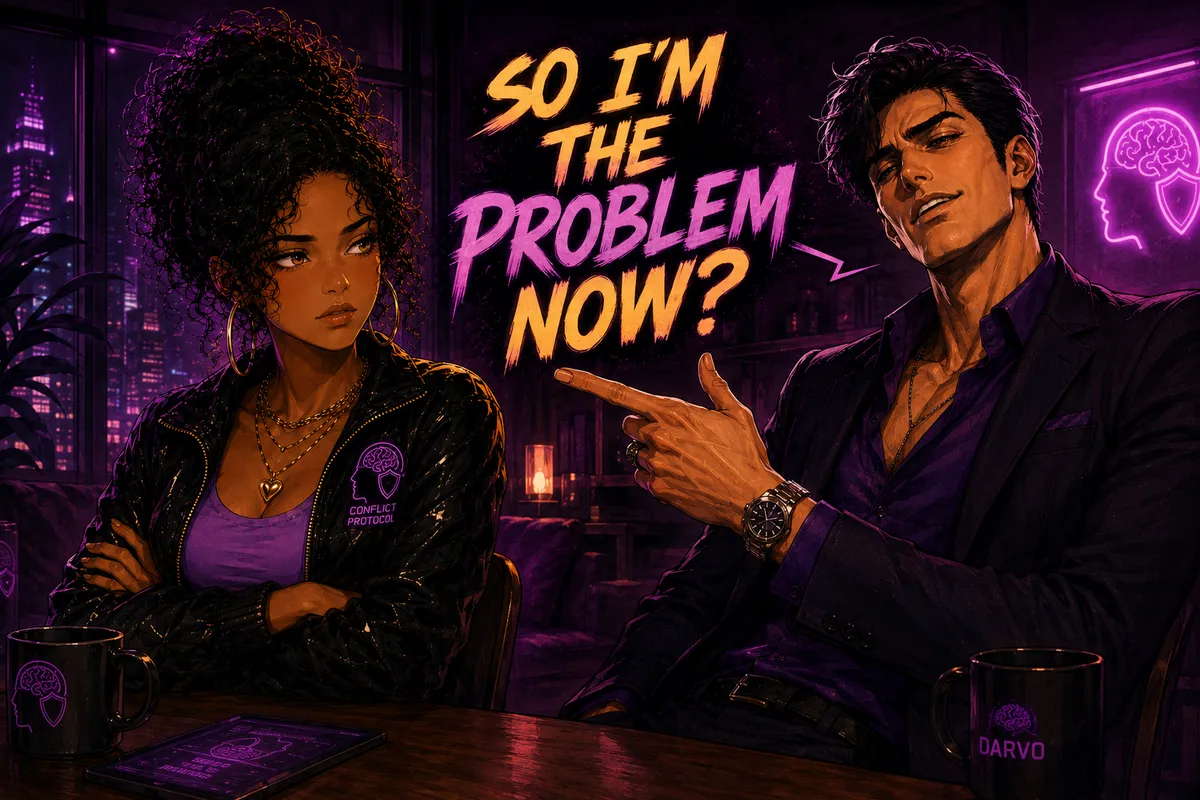
Friendship Jealousy Scripts: What to Say When a Friend Feels Replaced
Friendship jealousy can make normal independence feel like betrayal. The useful response is warm enough to keep dignity in the room and firm enough that your whole life does not become evidence.
Quick answer
Reassure once if it is true. Do not turn your friendships, plans, and ordinary independence into evidence.
Having other friends does not mean I am replacing you.
What this looks like
A friend treats new friends like abandonment.
A boundary gets called proof that you changed.
One scheduling conflict becomes a verdict on the whole friendship.
The reassurance trap
A jealous friend may need care. But if care keeps turning into proof, ranking, or cancellation, the conversation has become a loyalty test.
The trap is ranking people to calm the room. Do not create a scoreboard just because someone feels insecure.
Scripts by tone
Choose the line that matches the heat in the room.
Warm: Having other friends does not mean I am replacing you.
Clear: I may be choosing differently now. That does not make the boundary wrong.
Firm: I care about you. I'm not cancelling my plan to prove it.
Exit: I am not continuing if this becomes a loyalty test.
Common mistake
Do not rank people to calm the pressure. It teaches the pressure to come back stronger.
- Over-reassuring until your own plans disappear.
- Ranking people to calm the pressure.
- Defending your entire character instead of answering the request.
If they say you changed
Let change be allowed without letting it become a conviction.
I may be choosing differently now. That does not make the boundary wrong.
Having other relationships does not mean I am replacing you.
I care about the friendship. I am not cancelling my own plans to prove it.
Related techniques and patterns
Techniques: Validation, Boundary Setting, Broken Record.
Patterns: Proof-of-Care / Loyalty Pressure, Guilt Trip.
Patterns and techniques
Patterns and techniques in this article
Pressure pattern to watch for:
How to defend yourself:
These tags describe possible interaction patterns, not diagnoses or proof of intent. Look at repetition, context, power, and what happens after you respond.