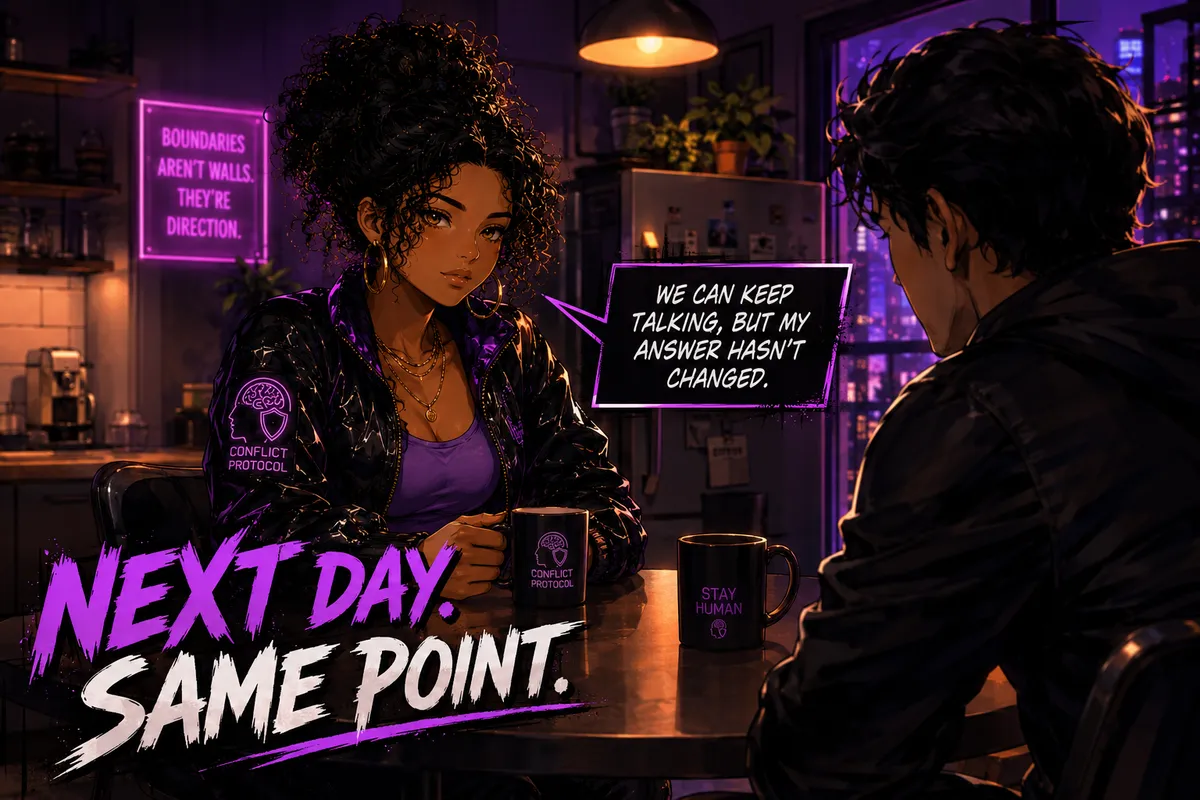
After the Conversation: Repair Scripts That Do Not Surrender Your Boundary
Sometimes the useful line arrives after the conversation. You over-explained, snapped, said yes too fast, or stayed quiet in public. Repair does not have to mean giving in.
Quick answer
Repair the delivery without deleting the boundary. Regret is not a blank check.
I should not have snapped. The boundary itself is still real.
What this looks like
You gave too many reasons and now need to restate the clean answer.
You regret your tone but still need the original boundary held.
You stayed composed under public criticism and need a factual follow-up.
Reset scripts by moment
Use the line that matches what actually happened. Do not write a bigger apology than the situation requires.
After over-explaining: I want to clarify my answer after thinking it through. I'm not available for that.
After snapping: I should not have snapped. The boundary itself is still real.
After saying yes too fast: I answered too quickly. I need to correct that: I'm not available for this.
Common mistake
An apology can repair tone. It does not have to delete the point you were trying to hold.
- Apologizing for having a boundary.
- Letting tone repair erase the original issue.
- Treating a pressured yes as permanent.
If they push back
Stay with the correction instead of writing a longer apology.
I can own my tone. My answer is still NO.
I am clarifying my answer, not reopening the debate.
I understand this is inconvenient. I am still not available.
Related techniques and patterns
Techniques: I-Statements, Don't Over-Explain - No JADE, Broken Record.
Patterns: Punitive Silence, Boundary Pressure, Don't Over-Explain - No JADE.
Patterns and techniques
Patterns and techniques in this article
Pressure pattern to watch for:
How to defend yourself:
These tags describe possible interaction patterns, not diagnoses or proof of intent. Look at repetition, context, power, and what happens after you respond.