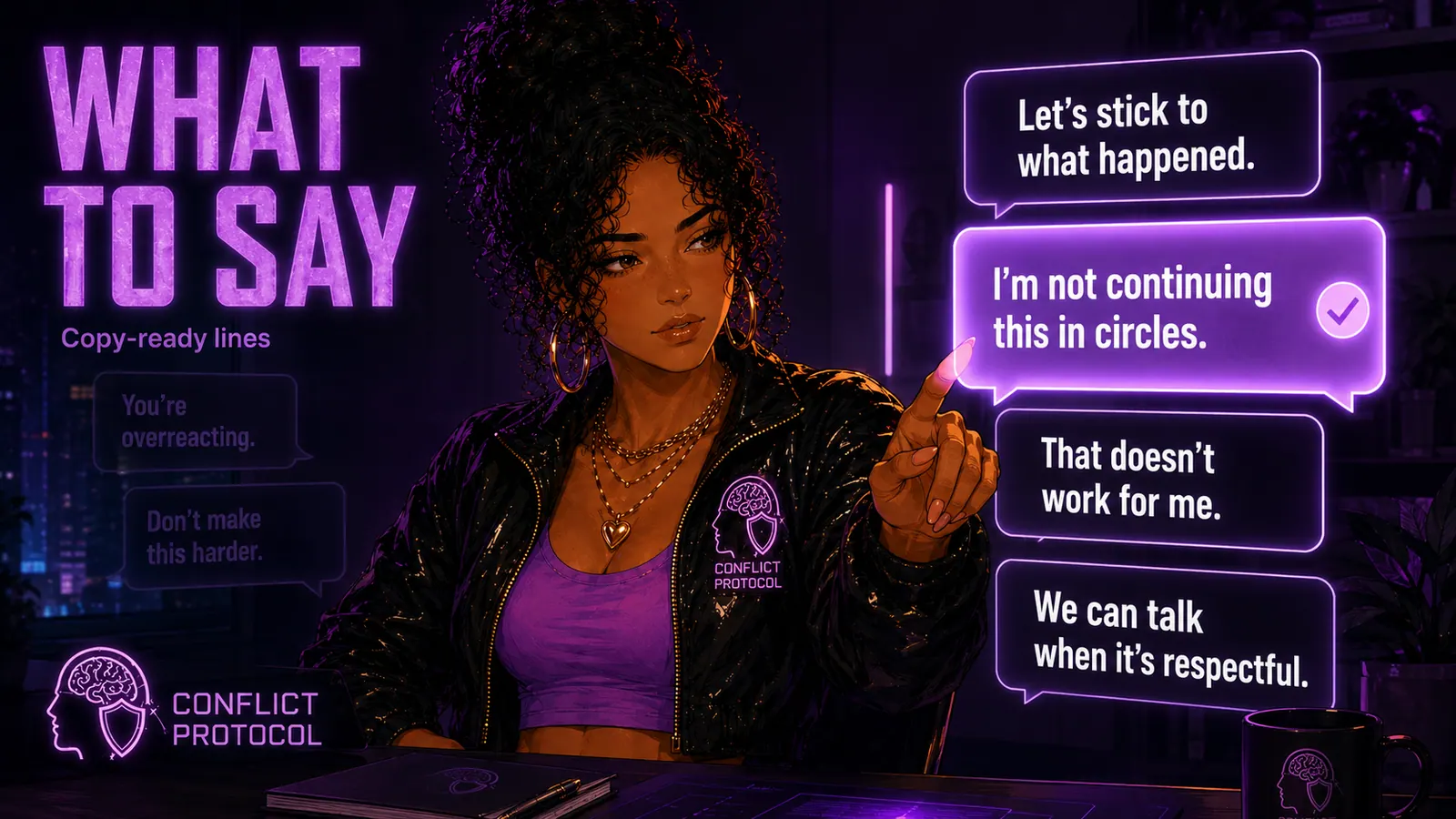




I need to buy time
I need to check before I answer.
Use when: The request is moving faster than your actual capacity check.
Why it works: Creates a pause before pressure becomes agreement.
Quick phrasebook
Find one line you can actually use. Search by situation, pressure line, or pattern.
Need words now? Start with I need words NOW. For twelve saveable lines, open the Pocket Card.
Simulator preview
This static sample shows the feedback format being built for interactive practice.
"That never happened. You always twist things."
"No, it did happen. I remember exactly where we were and what you said."
Memory-trial flag: proving every detail keeps you inside the argument they chose.
Flagged phrase: "I remember exactly where we were"
"We remember it differently. I'm not debating the memory all night. I'm talking about what I need going forward."
Rises when memory gets challenged
Recovers when the line exits the trial
Memory denial / blame reversal
Refuse the memory trial
Buy time
Say NO
Work pressure
Memory denial I need to check before I answer.
Use when: The request is moving faster than your actual capacity check.
Why it works: Creates a pause before pressure becomes agreement.
That does not work for me.
Use when: You need the short NO before you start defending it.
Why it works: It gives them less to pull apart.
I'm not debating my reason. My answer stays the same.
Use when: Your reason has become the handle for the argument.
Why it works: It closes the reason-trial and returns to the answer.
I've answered this. Repeating the question will not change my answer.
Use when: The same demand keeps returning in new words.
Why it works: It names repetition as pressure.
I hear that you're disappointed. I'm still not available.
Use when: Someone makes your limit sound like harm.
Why it works: It keeps care and compliance separate.
What should move if this becomes the priority?
Use when: Urgency is being used to skip tradeoffs.
Why it works: It turns panic into priority.
We can discuss my tone after we address the issue.
Use when: Your delivery is replacing the original concern.
Why it works: It sequences tone after substance.
I remember it differently, and I'm acting from my account.
Use when: The conversation has become a memory trial.
Why it works: It lets you act without winning confession.
My sensitivity is not the issue. The comment is the issue.
Use when: Your reaction is being used to hide the behavior.
Why it works: It returns attention to the behavior.
I hear that you meant it as a joke. I still want it to stop.
Use when: A hurtful comment is being minimized as humor.
Why it works: It accepts intent without surrendering impact.
I want to add attribution here: the original draft came from my work.
Use when: Your contribution is being absorbed into someone else's story.
Why it works: It corrects the record while staying specific.
I'm not comparing myself to them. My answer stays the same.
Use when: A comparison is being used to make you compete for approval.
Why it works: It refuses the contest.
I've answered this, so I'm going to step away now.
Use when: The loop is no longer producing anything useful.
Why it works: It turns the boundary into an action.
I can own my delivery. The boundary itself is still real.
Use when: You regret how it came out but not the limit.
Why it works: It separates repair from surrender.
I can discuss the details after this meeting.
Use when: The audience is becoming part of the pressure.
Why it works: It keeps the room from becoming the courtroom.
We can talk about your reaction after we address what happened.
Use when: The issue is being flipped into their injury.
Why it works: It refuses the reversal without attacking them.
I care about you. I'm not making this decision through guilt.
Use when: Guilt is becoming the decision-maker.
Why it works: It names care without handing over consent.
What exactly are you asking me to do, and by when?
Use when: The demand is vague enough to keep expanding.
Why it works: It makes the hidden ask measurable.
Please send the details in writing and I'll review them when I'm available.
Use when: A live ask is moving too fast or changing shape.
Why it works: It slows scope creep and creates a record.
I'm not debating my character. I'm answering the request.
Use when: The conversation has moved from the ask to who you are.
Why it works: It returns the conversation to the actual request.
I want to keep the attribution clear: the original draft and structure came from my work.
Use when: Your specific contribution is being blurred into vague group credit.
Why it works: It corrects attribution without attacking the person.
The original idea and direction came from me. The later edits do not erase that.
Use when: Someone frames their edits as the real ownership.
Why it works: It separates origin from refinement.
I can share the notes. I also want my role visible in the presentation.
Use when: Your analysis is being collected before ownership is clear.
Why it works: It attaches credit before the work travels.
I appreciate that. I want the contribution named more specifically.
Use when: Your primary work is being reduced to support language.
Why it works: It accepts partial credit while correcting the record.
Having other friends does not mean I am replacing you.
Use when: Normal independence is being framed as abandonment.
Why it works: It refuses the betrayal frame without going cold.
I may be choosing differently now. That does not make the boundary wrong.
Use when: Growth or independence is being treated as disloyalty.
Why it works: It accepts possible change without surrendering the limit.
I hear that you want more time. I'm not available tonight.
Use when: A scheduling conflict is becoming a global accusation.
Why it works: It validates the wish and answers the specific ask.
I care about you. I'm not cancelling my plan to prove it.
Use when: Care is being measured by whether you drop your own commitment.
Why it works: It separates care from compliance.
I want to clarify my answer after thinking it through. I'm not available for that.
Use when: You gave too many reasons and need to restate the actual answer.
Why it works: It removes the extra reasons and returns to the boundary.
I should not have snapped. The boundary itself is still real.
Use when: You regret delivery but not the limit.
Why it works: It owns tone without surrendering the point.
I answered too quickly. I need to correct that: I'm not available for this.
Use when: You agreed under pressure and need to walk it back.
Why it works: It makes the correction direct.
Following up on the meeting: I'm available to discuss performance concerns directly, not in front of the group.
Use when: You stayed narrow in the room and need to reset expectations afterward.
Why it works: It keeps the record factual and names the preferred channel.
I want to restart this conversation calmly. I still need us to address the original issue.
Use when: There was heat or avoidance, but the issue still needs a clean restart.
Why it works: It restarts without pretending the issue disappeared.
I need to check before I answer.
Use when: The conversation is moving too fast and you feel yourself agreeing too soon.
Why it works: Creates a pause before commitment.
I've answered this. Repeating the question will not change my answer.
Use when: They ask again with guilt, urgency, disappointment, or a new angle.
Why it works: Protects the answer from being exhausted.
I'm not discussing this tonight.
Use when: The conversation is too charged or too late to keep going cleanly.
Why it works: Turns the boundary into a time limit instead of another debate.
I hear you. I'm still not available.
Use when: They want disappointment, hurt, or urgency to decide your availability.
Why it works: Keeps warmth and the limit in the same sentence.
I'm not debating my reason. My answer stays the same.
Use when: You need a short line under pressure, not a full explanation.
Why it works: It stops the reason from becoming the new argument and returns to the answer.
Please send the details in writing and I'll review them when I am available.
Use when: You need a short line under pressure, not a full explanation.
Why it works: It moves a fast live ask into a record and ties the response to your availability.
I remember it differently, and I'm acting from my account.
Use when: You need a short line under pressure, not a full explanation.
Why it works: It lets you stop proving every detail before you are allowed to choose your next step.
I am going to step away now. We can talk later if there is something new.
Use when: You need a short line under pressure, not a full explanation.
Why it works: It ends the current exchange while leaving a narrow path back if the conversation changes.
They say
It's just one quick thing.
You say
What should move if this becomes the priority?
Use when: They say: "It's just one quick thing."
Why it works: It turns urgency into a tradeoff instead of a loyalty test.
They say
Can you join a quick call tonight?
You say
I'm offline tonight. Send the details and I'll review them tomorrow.
Use when: They say: "Can you join a quick call tonight?"
Why it works: It protects after-hours access without arguing.
They say
We need someone flexible.
You say
I can be flexible within agreed priorities. I'm not available for this tonight.
Use when: They say: "We need someone flexible."
Why it works: It defines flexibility instead of letting it mean unlimited availability.
They say
Let's discuss your mistake in front of everyone.
You say
I can discuss the details after this meeting.
Use when: They say: "Let's discuss your mistake in front of everyone."
Why it works: It moves detailed feedback out of the public pressure setting.
They say
Everyone else can handle pressure.
You say
My capacity is what I stated. What should move?
Use when: They say: "Everyone else can handle pressure."
Why it works: It returns the insult to capacity and priority.
They say
A real team player would stay.
You say
I can talk about priorities. I'm not available tonight.
Use when: They say: "A real team player would stay."
Why it works: It separates commitment from unpaid access.
They say
Just squeeze it in.
You say
I can do A or B today, not both.
Use when: They say: "Just squeeze it in."
Why it works: It makes the tradeoff visible.
They say
Why are you pushing back?
You say
I'm clarifying scope before I commit.
Use when: They say: "Why are you pushing back?"
Why it works: It keeps the issue operational.
They say
This should not take long.
You say
Please send the details in writing and I'll review the scope.
Use when: They say: "This should not take long."
Why it works: It slows a vague ask before it expands.
They say
I guess I don't matter.
You say
You matter to me. I'm still not available for this.
Use when: They say: "I guess I don't matter."
Why it works: It validates care without changing the boundary.
They say
You never visit anymore.
You say
I hear that you want more time together. I'm not available this weekend.
Use when: They say: "You never visit anymore."
Why it works: It answers the actual weekend instead of the global accusation.
They say
I sacrificed everything for this family.
You say
I respect what you gave. I'm still not handing over this decision.
Use when: They say: "I sacrificed everything for this family."
Why it works: It respects the past without letting it own the present.
They say
If something happens to me, don't blame yourself.
You say
If this is medical or urgent, please contact local support. I'm not making this decision through fear.
Use when: They say: "If something happens to me, don't blame yourself."
Why it works: It routes safety to support instead of compliance.
They say
Your cousin would never speak to me like this.
You say
I'm not comparing myself to them. My answer stays the same.
Use when: They say: "Your cousin would never speak to me like this."
Why it works: It refuses the comparison contest.
They say
After everything I've done for you...
You say
I know you gave a lot. I'm still not available for this.
Use when: They say: "After everything I've done for you..."
Why it works: It keeps gratitude separate from agreement.
They say
You will regret this.
You say
I hear that you're upset. I'm not deciding through guilt.
Use when: They say: "You will regret this."
Why it works: It names the pressure without escalating motives.
They say
So this is how you repay me?
You say
Gratitude does not mean automatic agreement.
Use when: They say: "So this is how you repay me?"
Why it works: It refuses the debt ledger.
They say
Everyone else makes time.
You say
I'm not comparing schedules. I'm telling you my availability.
Use when: They say: "Everyone else makes time."
Why it works: It returns to your actual capacity.
They say
You only care about yourself.
You say
I care about you. I'm still saying NO to this.
Use when: They say: "You only care about yourself."
Why it works: It separates care from compliance.
They say
I was just joking.
You say
I hear that you meant it as a joke. I still want it to stop.
Use when: They say: "I was just joking."
Why it works: It accepts intent without surrendering impact.
They say
You always make everything about you.
You say
I'm talking about one issue, not my whole character.
Use when: They say: "You always make everything about you."
Why it works: It returns from character to behavior.
They say
You're replacing me.
You say
Having other relationships does not mean I am replacing you.
Use when: They say: "You're replacing me."
Why it works: It reassures without surrendering autonomy.
They say
You promised. You just don't remember.
You say
I remember it differently, and I'm not going to argue memory in circles.
Use when: They say: "You promised. You just don't remember."
Why it works: It stops the memory trial.
They say
You always ruin the mood.
You say
The mood is not more important than the boundary.
Use when: They say: "You always ruin the mood."
Why it works: It keeps the limit visible.
They say
You're too sensitive.
You say
My sensitivity is not the issue. The comment is the issue.
Use when: They say: "You're too sensitive."
Why it works: It returns focus to the behavior.
They say
So now I'm the bad guy?
You say
We can talk about your reaction after we address what happened.
Use when: They say: "So now I'm the bad guy?"
Why it works: It refuses the reversal.
They say
That never happened.
You say
I remember it differently, and I'm acting from my account.
Use when: They say: "That never happened."
Why it works: It lets you act without their agreement.
They say
Nobody else has a problem with it.
You say
I'm telling you what I want to stop.
Use when: They say: "Nobody else has a problem with it."
Why it works: It does not outsource your boundary to the group.
They say
You are making this into drama.
You say
I'm talking about one issue. I want to stay with it.
Use when: They say: "You are making this into drama."
Why it works: It keeps the conversation concrete.
They say
Can you answer right now?
You say
I need to check before I answer.
Use when: They say: "Can you answer right now?"
Why it works: It breaks the speed trap.
They say
Your tone is the problem.
You say
We can discuss my tone after we address the issue.
Use when: They say: "Your tone is the problem."
Why it works: It sequences tone after substance.
They say
But why?
You say
I'm not adding more reasons. This is my answer.
Use when: They say: "But why?"
Why it works: It stops feeding the reason loop.
They say
I'm asking nicely now.
You say
I hear you. My answer is still NO.
Use when: They say: "I'm asking nicely now."
Why it works: It recognizes the tone change without reopening the decision.
They say
If you're sorry, take it back.
You say
I can own my delivery. The boundary itself is still real.
Use when: They say: "If you're sorry, take it back."
Why it works: It separates repair from surrender.
They say
Just explain it one more time.
You say
I've answered this. Repeating the question will not change my answer.
Use when: They say: "Just explain it one more time."
Why it works: It names repetition as pressure.
They say
That reason is not good enough.
You say
It does not need to be approved for my answer to stand.
Use when: They say: "That reason is not good enough."
Why it works: It removes their veto over your boundary.
They say
You sound defensive.
You say
I'm willing to say it calmly. I'm not dropping the point.
Use when: They say: "You sound defensive."
Why it works: It accepts process without abandoning substance.
They say
So is that a yes?
You say
No. I need to check before I answer.
Use when: They say: "So is that a yes?"
Why it works: It keeps temporary pause from becoming consent.
They say
I thought you apologized.
You say
I did. The boundary still stands.
Use when: They say: "I thought you apologized."
Why it works: It keeps repair proportional.
They say
I think this came from the team.
You say
I want to keep the attribution clear: the original draft and structure came from my work.
Use when: They say: "I think this came from the team."
Why it works: It corrects attribution without attacking the person.
They say
I polished your rough idea.
You say
The original idea and direction came from me. The later edits do not erase that.
Use when: They say: "I polished your rough idea."
Why it works: It separates origin from refinement.
They say
We all contributed equally.
You say
I want to separate collaboration from contribution level. My role included the draft, data pull, and recommendation.
Use when: They say: "We all contributed equally."
Why it works: It keeps teamwork from flattening the actual work.
They say
Can you send me your notes? I'll present it.
You say
I can share the notes. I also want my role visible in the presentation.
Use when: They say: "Can you send me your notes? I'll present it."
Why it works: It attaches ownership before the work travels.
They say
So you have new friends now?
You say
Having other friends does not mean I am replacing you.
Use when: They say: "So you have new friends now?"
Why it works: It refuses the betrayal frame without over-reassuring.
They say
You changed.
You say
I may be choosing differently now. That does not make the boundary wrong.
Use when: They say: "You changed."
Why it works: It avoids the identity trial and returns to the boundary.
They say
I guess I know where I stand.
You say
I hear that you're hurt. I'm not going to turn one decision into a ranking of people.
Use when: They say: "I guess I know where I stand."
Why it works: It names the hurt without accepting the ranking frame.
They say
If you cared, you would cancel.
You say
I care about you. I'm not cancelling my plan to prove it.
Use when: They say: "If you cared, you would cancel."
Why it works: It separates care from cancelling.
They say
But you already said yes.
You say
I answered too quickly. I need to correct that: I'm not available for this.
Use when: They say: "But you already said yes."
Why it works: It makes the correction clear without a long defense.
They say
You snapped, so now you're wrong.
You say
I should not have snapped. The boundary itself is still real.
Use when: They say: "You snapped, so now you're wrong."
Why it works: It owns delivery without deleting the boundary.
They say
So now you want to change your story?
You say
I want to clarify my answer after thinking it through.
Use when: They say: "So now you want to change your story?"
Why it works: It frames the follow-up as clarification, not a debate restart.
They say
It's just one quick thing.
You say
What should move if this becomes the priority?
Use when: They say: "It's just one quick thing."
Why it works: It turns urgency into a tradeoff instead of a loyalty test.
They say
Can you just explain why?
You say
I'm not debating my reason. My answer stays the same.
Use when: They say: "Can you just explain why?"
Why it works: It keeps your answer from becoming dependent on their approval of your reason.
They say
I think this came from our team.
You say
I want to add attribution here: the original draft came from my work.
Use when: They say: "I think this came from our team."
Why it works: It corrects the record with a specific claim instead of a vague accusation.
Fine, I guess I'll do it.
It accepts the hidden weekend work without clarifying scope, priority, or tradeoff.I can take this up Monday. What should move if this becomes the priority?
Use when: It accepts the hidden weekend work without clarifying scope, priority, or tradeoff.
Why it works: It delays the work to a normal boundary and makes the new ask compete with existing priorities.
Fine, I'll cancel my plans.
It lets guilt decide your availability.I know you gave a lot. I'm still not available for this.
Use when: It lets guilt decide your availability.
Why it works: It acknowledges the history without turning gratitude into automatic availability.
Yes it did, and here are every single detail and timestamp.
It can trap you in an endless memory trial.I remember it differently, and I'm acting from my account.
Use when: It can trap you in an endless memory trial.
Why it works: It lets you act from your account without needing the other person to certify your memory.
Let me explain it one more time.
It teaches the loop that more pressure earns more material.I've answered this. Repeating the question will not change my answer.
Use when: It teaches the loop that more pressure earns more material.
Why it works: It makes repetition ineffective by refusing to add new reasons after the answer is clear.
Wow, nice of you to steal my work.
It may be satisfying, but it makes the correction easier to dismiss as drama.I want to add attribution here: the original draft came from my work.
Use when: It may be satisfying, but it makes the correction easier to dismiss as drama.
Why it works: It corrects attribution with the specific contribution that needs to be recorded.
No matching lines yet. Try a shorter search, or start with Buy time.